Motif Studies
Forms and Symbolism of Cloud Motifs in Qing Textiles
清代云纹的形态与象征
- Author
- Xiaojian Li
- Year
- To be added
Abstract
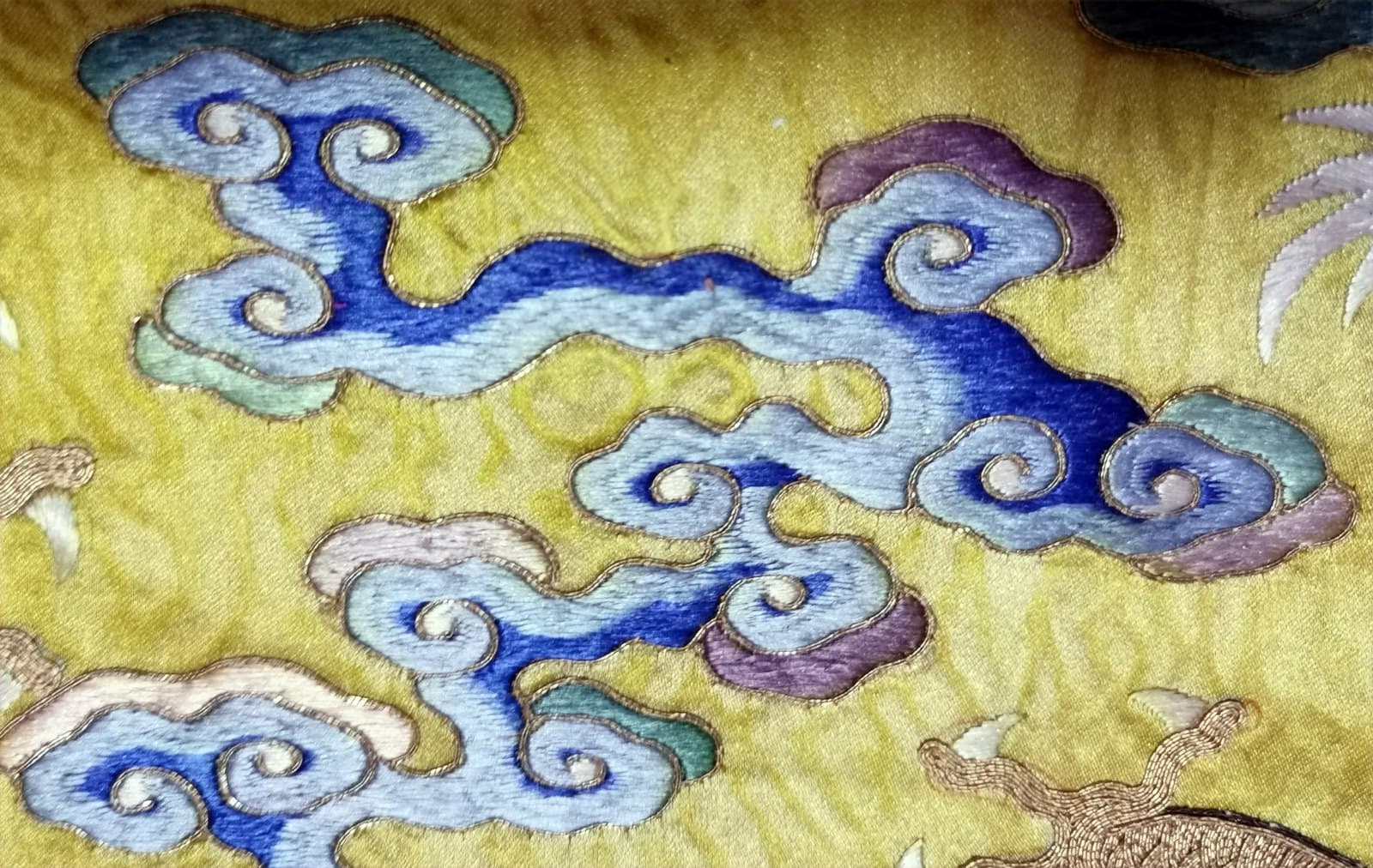
Cloud motifs in Qing textiles are at once ornament and structure. Beginning from the basic unit of head and tail, this study examines changes in density, arrangement and interlocking across the dynasty, and describes the work clouds do compositionally — dividing, linking and supporting — together with the shifting relationship between cloud and principal motif.
Keywords
- cloud motif
- composition
- Qing textiles
- motif studies
A cloud is built from two elements: a head, shaped like a lingzhi fungus or the head of a ruyi sceptre, and a trailing tail. The pairing was already settled before the Qing; what changes in the Qing is the relationship between units rather than the unit itself.
Early Qing clouds are set out sparsely. Units stand apart, with generous ground between them; the head is full, the tail relatively short, and the overall distribution is punctual. Their role is to separate — to give the dragon or other principal figure a clear silhouette.
From the middle of the dynasty the clouds multiply and the tails lengthen. Adjacent tails begin to hook into one another, forming continuous bands. The function shifts from separating to linking: the clouds now knit scattered motifs into a continuous surface.
Later still the density increases further, and in some examples the cloud band covers nearly the whole ground, so that difference in tone and colour becomes the main means of distinguishing figure from field. The change belongs to a broader taste for density, and also to the way weaving and embroidery divided their labour.
Symbolically, clouds point to auspicious omen and the celestial realm. But their meaning on dress rarely stands alone: clouds almost always appear with dragons, wave-and-mountain borders and sun discs, forming a complete scheme. Read apart from that combination, cloud symbolism easily becomes speculation.
For dating, then, density and arrangement are more reliable indicators than the shape of any single cloud — one of the steadier observations available in object-based work.
References
To be added
Cite this article
Xiaojian Li, “Forms and Symbolism of Cloud Motifs in Qing Textiles”, n.d.. Xiaojian Li Archive. https://chinastitches.com/en/research/forms-and-symbolism-of-qing-cloud-motifs