Motif Studies
Evolution of Dragon Motifs During the Qing Dynasty
清代历朝龙纹的演变
- Author
- Xiaojian Li
- Year
- To be added
Abstract
The dragon is the most tightly regulated motif in Qing dress, yet its form changes continuously across more than two centuries. Working from surviving garments, this study sets out the successive characteristics of the Qing dragon under five headings — the proportion of the head, the treatment of the mane, the form of the claw, the movement of the body, and its relation to the surrounding clouds — and considers the limits of using the motif as evidence for dating.
Keywords
- dragon motif
- Qing dress
- dating
- object-based research
- motif development
Qing regulation was explicit about who might use dragons: five claws for the long, four for the mang, with the number, placement and treatment fixed by rank. But regulation governed entitlement, not draughtsmanship. What makes a textile look as though it belongs to one reign rather than another lies in details the rules never addressed — habits of the workshop, accumulated and passed on.
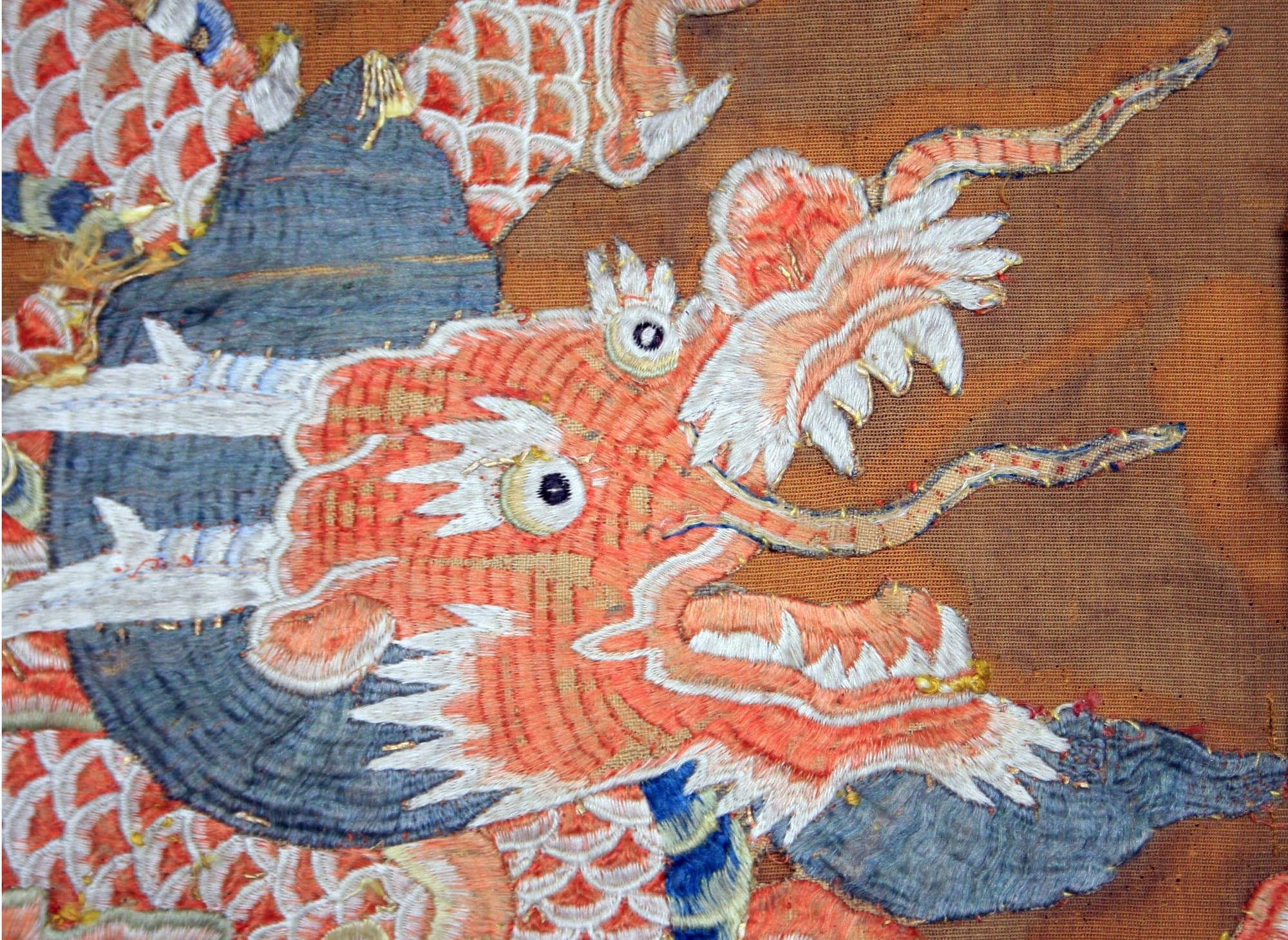
Proportion of the head is the first thing one notices. In the early Qing the head is relatively small against the body, the features gathered close, the brow shallow. From the middle of the dynasty the head grows larger, the brow swells, and the snout turns up more sharply. By the late Qing the head can occupy a conspicuously large share of the composition, and its junction with the body sometimes reads as abrupt.
The mane follows its own sequence. Early examples show few strands, loosely drawn and streaming back. These multiply and thicken over time, and begin to be grouped into locks. Later work tends towards symmetry and pattern: the mane loses its sense of movement and gains decorative weight.
The claw must be read together with the technique. Kesi, worked with discontinuous wefts, tends to reduce the claw to a simpler outline; embroidery can articulate each joint through the direction of the stitch. Comparison is therefore only sound within one technique and one class of object — set a kesi dragon beside an embroidered one and the difference in handling will be mistaken for a difference in date.
The movement of the body against the clouds registers a change in compositional thinking. Early Qing dragons are extended, with ample ground between body and cloud, and a clear hierarchy between the two. Later, the clouds grow denser, their tails lengthen and interlock, and the dragon is increasingly embedded within the cloud band; the distinction between principal motif and ground weakens accordingly.
All of these are tendencies, not tests. Surviving textiles include altered garments, later additions, later copies and the products of provincial workshops. Any dating requires the mutual support of several kinds of evidence — fibre, weave structure, tailoring and the marks left by use. The dragon offers a lead, not a verdict.
References
To be added
Cite this article
Xiaojian Li, “Evolution of Dragon Motifs During the Qing Dynasty”, n.d.. Xiaojian Li Archive. https://chinastitches.com/en/research/evolution-of-qing-dragon-motifs