Papers
Qing Imperial Costume Regulations Through Surviving Objects
从传世实物看清代宫廷服饰制度
- Author
- Xiaojian Li
- Year
- To be added
Abstract
Qing dress regulation set out in writing the forms, motifs and colours available to each rank, yet surviving garments do not always answer to the text. This paper distinguishes three relations between object and regulation — conformity, divergence and adjustment — and argues for the value of material evidence in understanding how the system actually worked.
Keywords
- costume regulation
- Qing court
- object-based research
- rank
- court dress
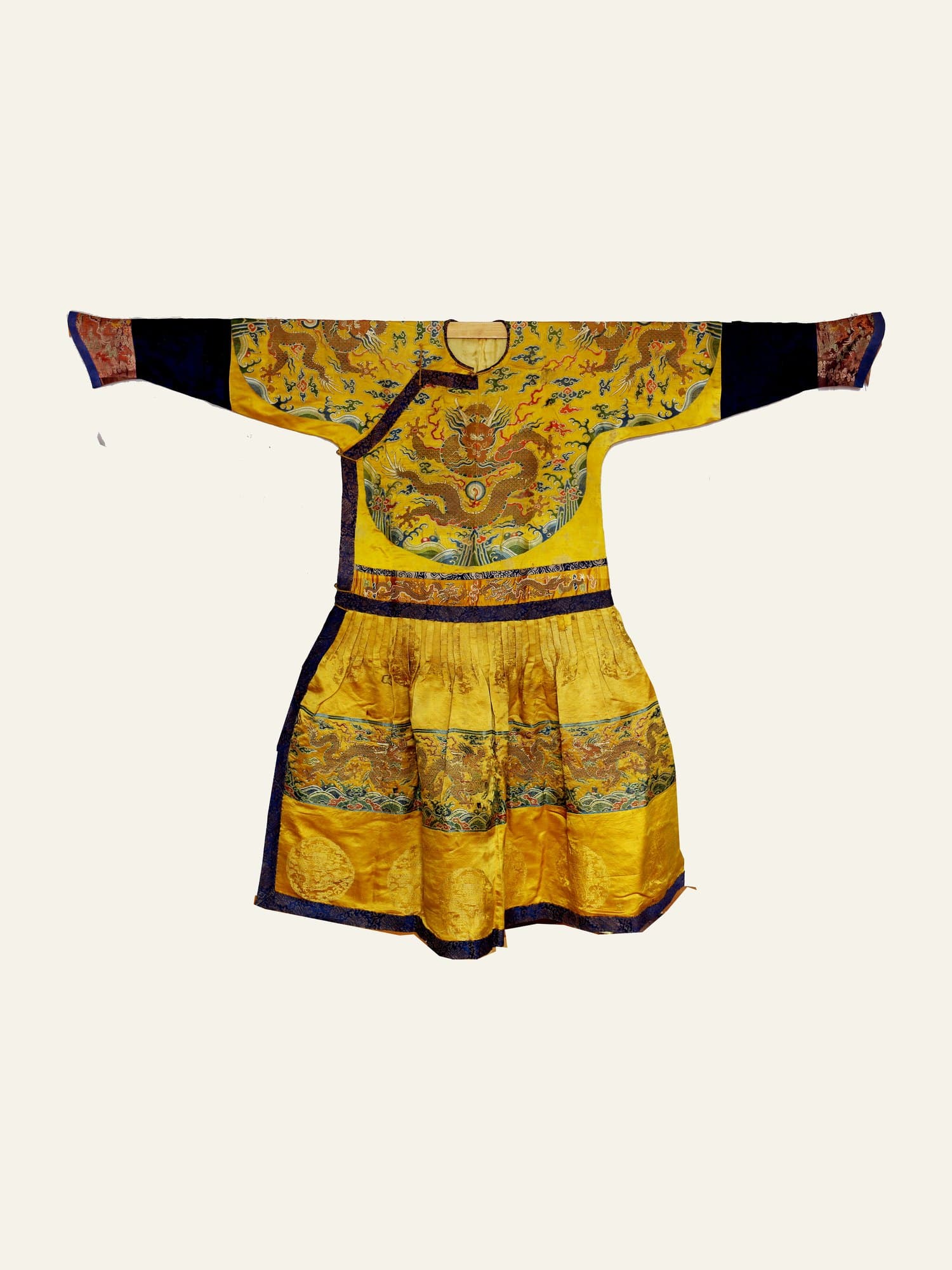
Qing dress regulation is an extensive body of rule, covering formal court dress, festive dress, everyday and travelling wear and rain garments, and specifying in detail the motifs, colours, materials and accessories available at each grade. The text supplies the basic framework for understanding Qing dress.
But the text describes what ought to be. Surviving garments show what became of those rules over more than two centuries of enforcement, interpretation and accommodation. The distance between the two is where the research begins.
The first relation is conformity. A considerable number of court garments agree closely with the regulations in construction and in the number and placement of motifs. These objects can be used to check one’s reading of the text, and to serve as a baseline against which other examples are measured.
The second is divergence. It may be a matter of time, since the regulations were revised at intervals; of place, since provincial weaving establishments and the palace workshops did not produce identical goods; or of later alteration and recombination. Determining which requires material evidence — seams, joins in the cloth, the distribution of wear.
The third is adjustment. Some garments show deliberate accommodation: without breaching the rules of rank, distinction is registered instead through density of ornament, choice of colour or sheer quality of execution. Such adjustments seldom appear in the written record and can only be read from the objects.
The value of object-based work is not that it contradicts the regulations but that it completes them. The text tells us how the rule was written; the garment tells us how it was used. Only together do they describe how Qing dress actually operated.
References
To be added
Cite this article
Xiaojian Li, “Qing Imperial Costume Regulations Through Surviving Objects”, n.d.. Xiaojian Li Archive. https://chinastitches.com/en/research/qing-costume-regulations-through-objects