Object Studies
Reading Kesi: Technique and Identification
缂丝的工艺特征与识别
- Author
- Xiaojian Li
- Year
- To be added
Abstract
Kesi is woven with continuous warps and discontinuous wefts, leaving the fine slits at the edge of each colour area that are its most immediate identifying feature. This study sets out the principle of the technique, the common methods of changing colour, and the points to observe in distinguishing kesi from embroidery and from figured weaving.
Keywords
- kesi
- technique
- identification
- object-based research
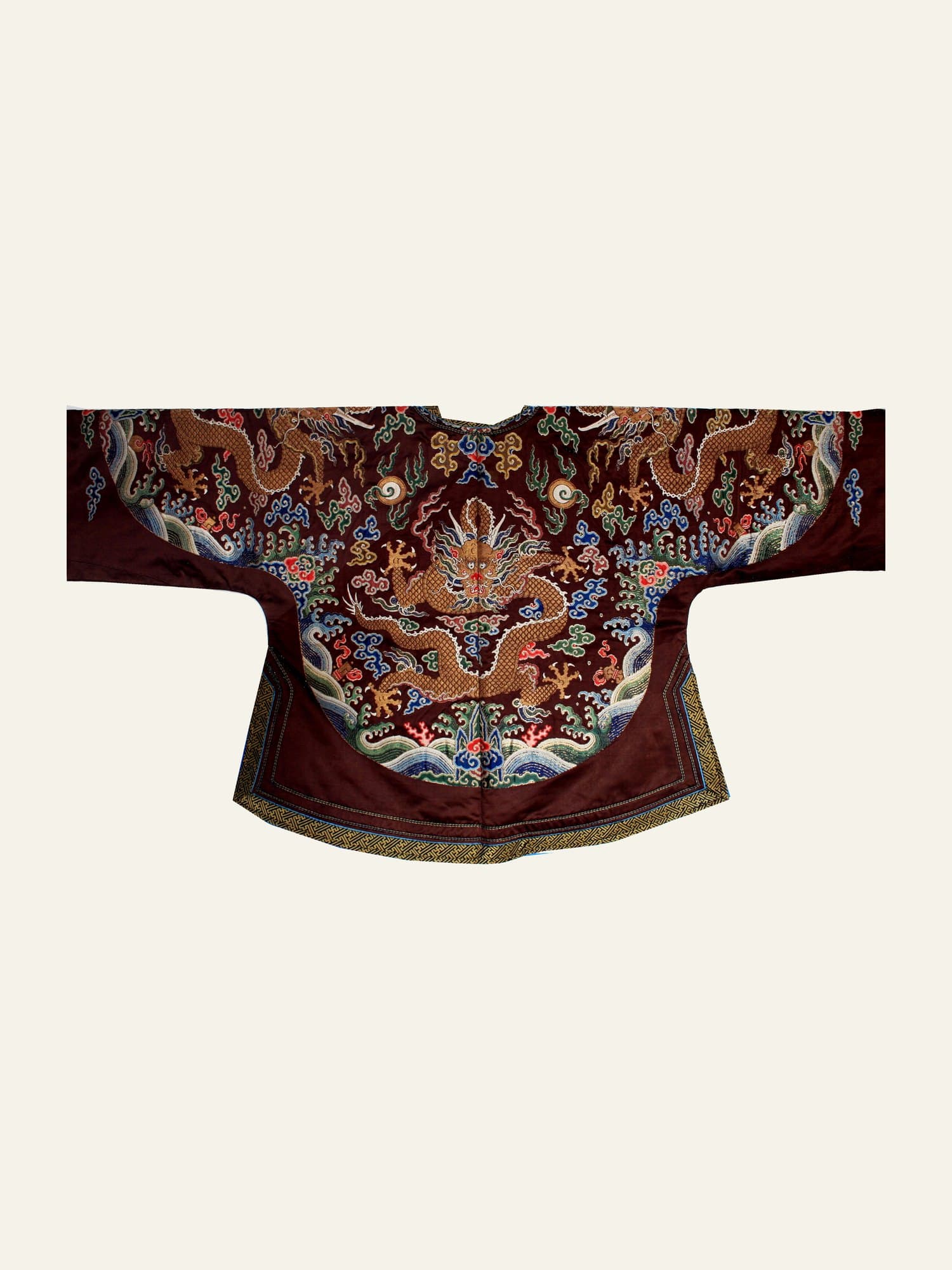
The principle of kesi is continuous warp and discontinuous weft: the warps run the full width of the cloth, while each weft travels back and forth only across the area of colour it fills. Adjacent areas are not joined, and so leave the fine vertical slits — the “kesi mark” — along their shared edge.
Identification begins with those slits. Held to the light, the boundaries between colours should show a regular fine gap. Where the edge of a motif is entirely continuous, figured weaving or embroidery should be considered instead.
Next, compare the two faces. In kesi the design reads much the same on both sides, differing only where wefts are joined. Embroidery shows obvious carried threads and knots on the reverse; figured weaving generally shows floats of the pattern wefts on the back.
Several methods of changing colour are in use, and each produces a different effect at the junction between areas. Recognising them helps in gauging the complexity of a piece and narrowing its likely date, but the distinctions are learned only through repeated comparison of actual objects.
References
To be added
Cite this article
Xiaojian Li, “Reading Kesi: Technique and Identification”, n.d.. Xiaojian Li Archive. https://chinastitches.com/en/research/reading-kesi-technique